SwachhSignal - Smarter Hygiene Monitoring for Public Toilets
An AI-assisted hygiene monitoring system combining smart sensors and citizen feedback to identify and resolve issues faster.
Role: UX Lead ⚬ Domain: Civic Tech, Public Services ⚬ Platform: IoT, Mobile, Web Dashboard ⚬ Focus: AI-Assisted Monitoring, Service Design
Context
Connecting citizens, sensors, and sanitation teams.
SwachhSignal is an AI-assisted hygiene monitoring system designed to improve the cleanliness and maintenance of public toilets across India. The system combines smart sensors installed within public toilets with citizen feedback and AI-assisted monitoring to identify hygiene and maintenance issues.
The experience serves multiple stakeholders across the sanitation ecosystem - citizens using public toilets, sanitation workers responsible for maintenance, and administrators who need visibility into hygiene conditions and service performance. Each stakeholder has a different need, but they are connected by one shared outcome: a cleaner, safer, and better-maintained public toilet.
Public toilet hygiene can change throughout the day, while maintenance teams often rely on periodic inspections or complaints to identify problems. SwachhSignal explores how real-time signals, citizen reporting, and AI-assisted prioritization can create a more proactive system - helping teams identify issues earlier and respond where attention is needed most.
Challenge
From reactive maintenance to proactive hygiene management.
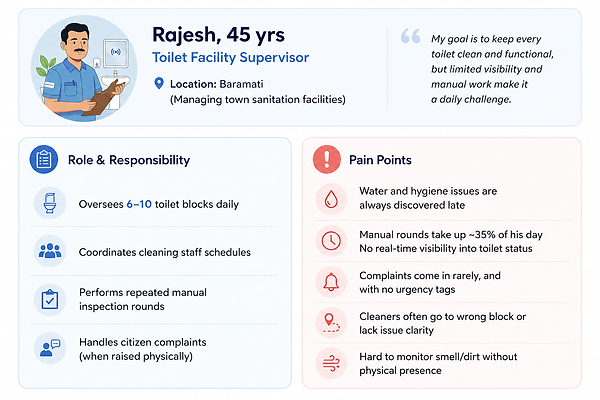
A toilet may become unusable between scheduled cleaning rounds, while sanitation teams may only learn about an issue through manual inspections or citizen complaints. At the same time, not every complaint requires the same level of urgency, making it difficult to determine what needs attention first and where resources should be directed.
The experience needed to address several interconnected challenges:
-
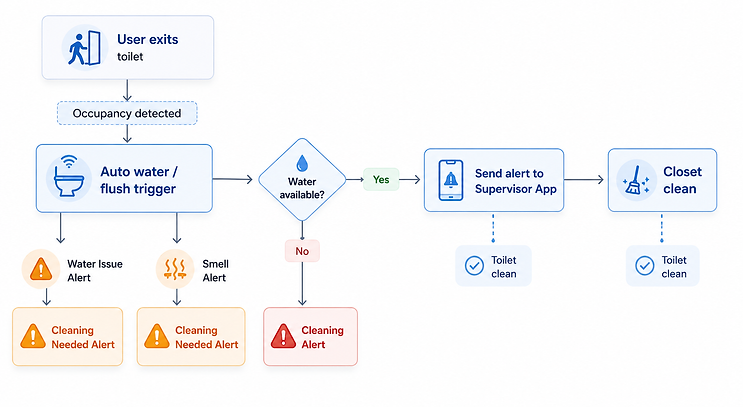
Water availability - Water may be unavailable after use due to manual dependency.
-
Unpleasant odor - Strong foul smells can make toilets uncomfortable and discourage usage.
-
Visible dirt - Unclean seats and floors reduce trust and increase avoidance.
-
Limited reporting - Citizens lack a simple, accessible, and anonymous way to report issues.
-
Manual inspections - Supervisors rely on repeated physical inspections, making monitoring inefficient and inconsistent.
-
Reactive maintenance - Cleaning and maintenance often begin only after an issue is noticed or reported, leading to delays.
Objective
Detect earlier. Prioritize smarter. Resolve faster.
SwachhSignal aims to connect smart sensors, citizen feedback, AI-assisted insights, and sanitation teams to create a continuous hygiene monitoring loop. The experience would help identify and prioritize issues based on urgency and impact, route them to the right people, and provide visibility through resolution—while keeping reporting simple and accessible for citizens.
Strategy
Shift public toilet maintenance from reactive complaint handling to proactive, data-informed action.
The strategy focused on creating a connected service where sensors and citizen feedback provide signals, AI helps interpret and prioritize those signals, and sanitation teams take action based on clear, actionable information. Instead of treating every complaint equally, the system surfaces issues based on urgency, severity, and context, helping teams focus their limited resources where they are needed most.
The experience was designed around a continuous loop:
Detect → Understand → Prioritize → Assign → Resolve → Verify
This approach ensures that technology supports the people responsible for maintaining public toilets, while citizens remain an important part of the feedback loop rather than being expected to manage the problem themselves.

Approach
The approach focused on connecting real-world hygiene conditions with timely, actionable intervention.
The experience was designed around the complete hygiene monitoring journey - from detecting an issue to resolving and verifying it. Smart sensors provide continuous signals from the toilet environment, while citizen feedback adds a human perspective when an issue is noticed. AI then helps interpret these signals, identify patterns, assess urgency, and surface the issues that require attention.
The system connects these insights with sanitation teams through a clear workflow, helping them understand what happened, where it happened, how urgent it is, and what action is required. The approach also considered accessibility and low-friction reporting so that citizens could participate without needing to navigate a complex process.
Detect → Understand → Prioritize → Act → Verify becomes the core experience loop, shifting maintenance from reactive response to proactive intervention.

Impact
Improving access to cleaner, safer, and more trustworthy public sanitation.
-
Greater confidence to use public toilets - Cleaner, better-maintained facilities can reduce hesitation and avoidance.
-
Potentially lower sanitation-related health risks - Timely cleaning and maintenance can help reduce exposure to unhygienic conditions, particularly for women, children, and older adults.
-
More responsive public services - Shifts sanitation management from periodic inspection to continuous monitoring and timely intervention.
-
Scalable across public spaces - The model can extend to railway stations, malls, markets, highways, transit hubs, and smart-city infrastructure.
-
Greater accountability - Creates a traceable connection between an issue being detected or reported and its resolution.